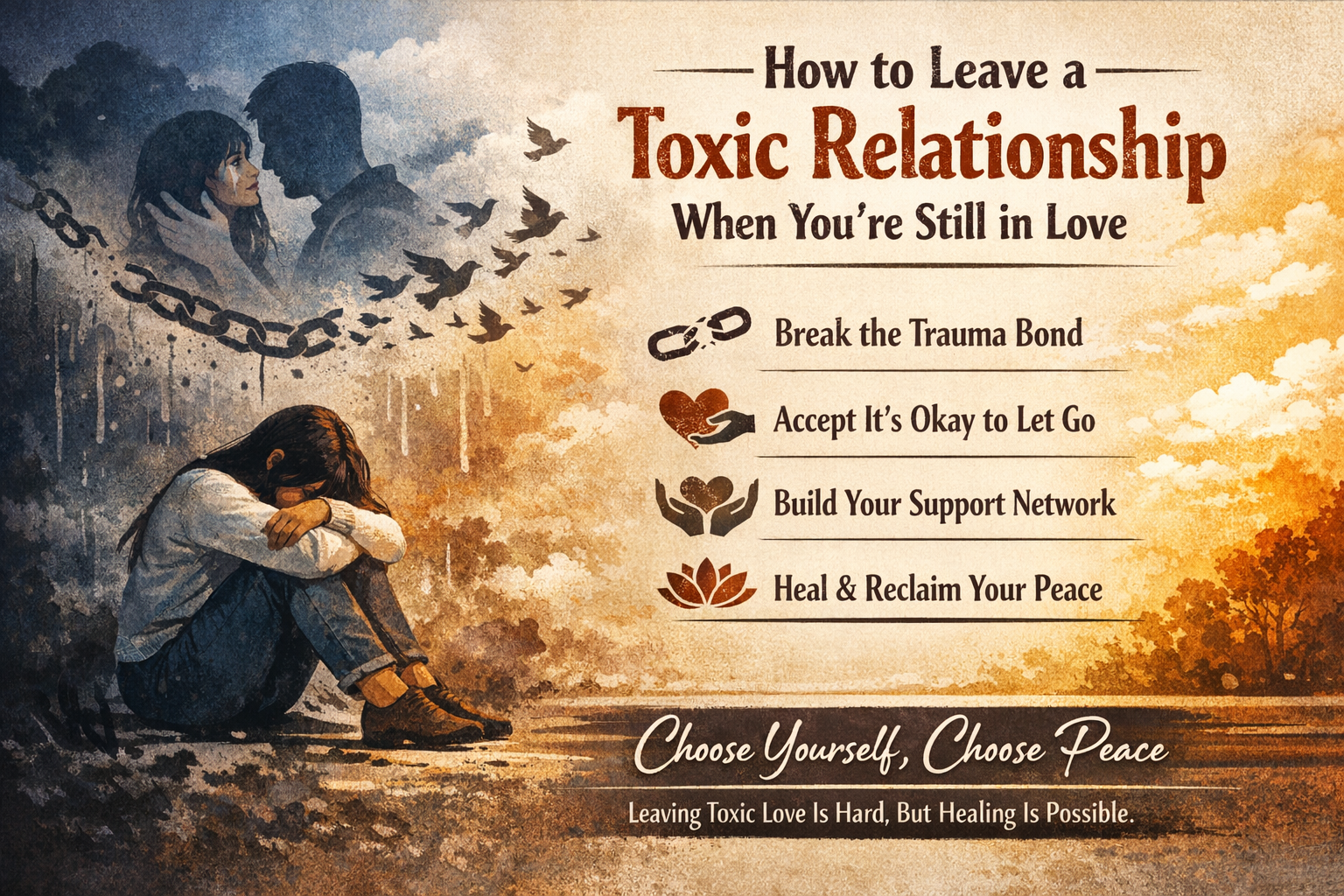
How to Leave a Toxic Relationship When You’re Still in Love
When Love Isn’t Enough
It hurts to love someone passionately and know they aren’t good for you.
You remember the happy times.
You recall how they laughed.
You keep the version of them that made you feel safe.
But nevertheless…
Your anxiety has gotten worse.
Your self-worth has gone down.
Your nervous system is always on edge.
Your body is exhausted in ways that sleep can’t help.
If you’re here, you probably don’t need to inquire if the relationship is bad for you. You already know. The actual question that keeps you up at night is:
How can I leave while I still care about them?
For a lot of health-conscious adults, especially in Tier One nations where emotional awareness, therapy, and self-growth are important, this problem feels like a battle between the heart and the mind.
What Is a Toxic Relationship?
A toxic relationship is one in which one or both partners continuously cause emotional hurt, manipulation, instability, or psychological anguish, making the partnership harmful instead than helpful.
Toxic dynamics may involve:
- Manipulation of emotions
- Gaslighting
- Control or being alone
- Abuse of words
- Constant disrespect
- Periods of extreme highs and lows
Arguments don’t make a relationship toxic, all healthy relationships have problems. It is characterized by patterns that undermine your mental health, self-esteem, and emotional equilibrium.
Why It’s So Hard to Leave When You’re Still in Love
Love doesn’t switch off just because logic tells it to.
Here’s why leaving feels almost impossible.
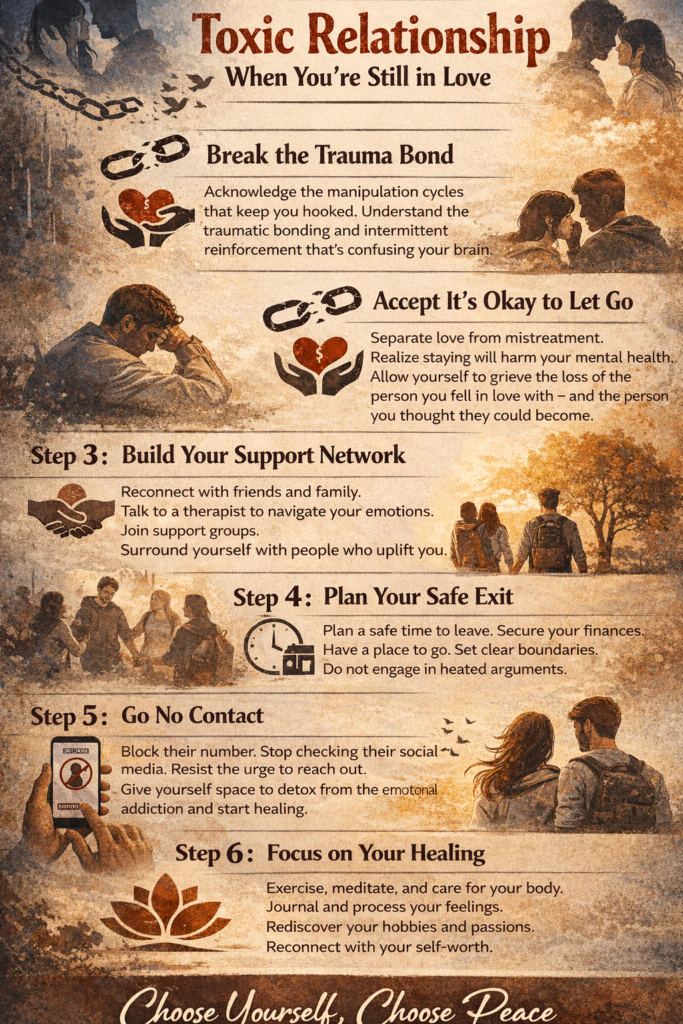
1. Trauma Bonding and Intermittent Reinforcement
Your brain gets addicted when love and abuse are blended together.
This is what the cycle looks like:
- Conflict or hurt feelings
- Distance or pulling away
- Sorry or love
- Very close
- Do it again
Psychologists call this kind of unpredictability “intermittent reinforcement” which is the same thing that makes gambling addicting.
Your brain starts to want the “good version” of them.
That doesn’t imply you’re weak.
It signifies that your nervous system has been trained.
2. You’re Attached to Potential, Not Reality
A lot of people don’t remain because of who their partner is.
They stay because of who their partner might be.
You remember:
- The first stage of love bombing
- The plans for the future
- The promises
You convince yourself, “If they only go to therapy.”
“If they just stop drinking.”
“If they just talked to each other more.”
But love based on what could happen is a fiction.
Consistent behavior is what makes relationships healthy.
3. Your Nervous System Is Addicted to the Chaos
Toxic connections mess up your nervous system.
You might feel:
- Worrying all the time
- Problems with sleep
- Hypervigilance
- Feeling emotionally drained
- Problems with the gut
- High cortisol
It’s funny that when things calm down, you could feel restless since chaos has been your normal.
A lot of health-conscious people are confused because they say, “I meditate.” I eat well. I see a therapist. Why can’t I go?
Because trauma links are not only emotional; they are biological as well.
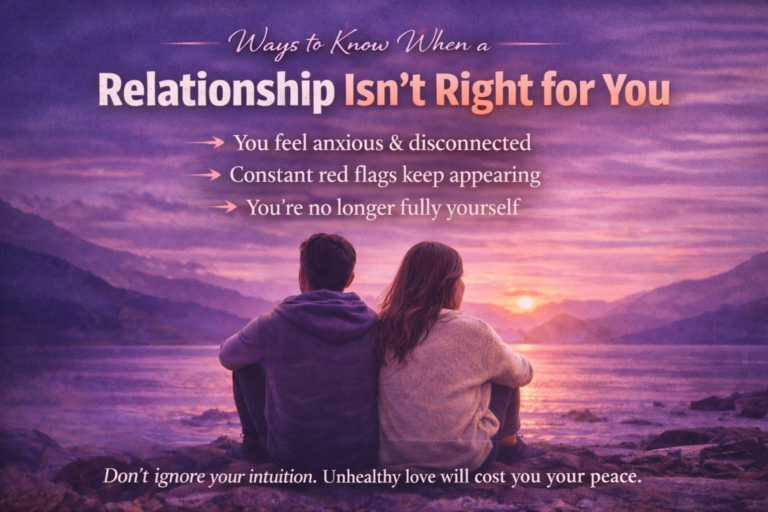
Signs You’re in a Toxic Relationship
You might not observe physical abuse.
But poison typically hides in small patterns.
You feel:
- Smaller surrounding them
- Not as sure
- More worried than before
- Too scared to talk about problems
- After talking, I feel emotionally spent.
- In charge of their feelings
- Feeling bad for desiring space
One strong test:
That’s not love if you always feel confused, frightened, or that you can’t trust your own judgment. That is not being stable emotionally.
Step 1: Accept That Love and Compatibility Are Different
You can love someone deeply and still not be compatible with them.
Compatibility includes:
- Emotional maturity
- Conflict resolution skills
- Respect
- Shared values
- Safety
Love is a feeling.
Compatibility is a structure.
Without structure, love collapses.
Step 2: Separate Who They Are From How They Make You Feel
Write this sentence down:
“I love them, but I do not love how I feel in this relationship.”
Notice the difference.
You may love:
- Their humor
- Their intelligence
- Their history with you
- The intimacy
But you do not love:
- The anxiety
- The disrespect
- The instability
- The walking-on-eggshells feeling
That distinction is the beginning of detachment.
Step 3: Stop Romanticizing the Highs
In toxic love, the good times feel great because the bad times are so bad.
Love that is healthy feels steady.
Toxic love feels like a drug.
Think about this:
Would you want a job that paid well but verbally abused you every week?
Would you be okay with a friend who just cared about you sometimes?
Why are there various rules for romance?
Step 4: Create a Reality Inventory
This is one of the most effective mental exercises.
Split a page into two parts:
Column 1: Who they always are
Column 2: Who I want them to be
Be quite honest.
This activity often shows that you’re grieving for something that isn’t real.
Step 5: Build Emotional Support Before You Leave
Leaving when you’re alone is bad for your mental health.
Before it ends:
Get back in touch with pals
Get therapy or counseling
Make family ties stronger
If you need to, work on becoming financially independent.
Ending a bad relationship is not only emotional; it is also practical.
Call local domestic violence resources or crisis hotlines if there is abuse.
Step 6: Plan the Exit Strategically
Impulsive breakups often lead to relapse.
Instead:
- Decide your date
- Plan where you will stay
- Remove shared financial entanglements
- Prepare for emotional backlash
When you leave, keep it simple.
You don’t need to convince them.
You don’t need them to agree.
You only need to decide.
What Happens After You Leave (The Withdrawal Phase)
No one talks about this part enough.
You may experience:
- Intense cravings to text them
- Panic
- Doubt
- Romantic flashbacks
- Physical heaviness
- Emotional grief
This is not proof you made a mistake.
It is your nervous system detoxing from unpredictability.
The first 30–60 days are often the hardest.
No-contact is critical.
Every message reopens the wound.
How to Heal Your Nervous System After Leaving
Health-conscious individuals often underestimate how much stress toxic relationships cause.
To regulate:
- Prioritize sleep hygiene
- Reduce caffeine
- Walk daily
- Practice breathwork
- Journal intrusive thoughts
- Limit social media stalking
Trauma lives in the body.
Healing must involve the body.
Rebuilding Your Identity After Toxic Love
Toxic relationships slowly erode identity.
Ask yourself:
- What did I stop doing?
- Who did I stop being?
- What hobbies disappeared?
Reclaiming identity is not dramatic.
It’s quiet.
It’s slow.
It’s powerful.
Take one small action daily that belongs only to you.
Frequently Asked Question
Is it normal to still love someone who was rude to you?
Yes. Just because someone hurt you doesn’t mean you stop caring about them. Trauma bonding and emotional history make it hard to let go.
How do I leave if I’m terrified of being by myself?
People typically stay in toxic relationships because they are afraid of being alone. But loneliness doesn’t last forever. Long-term mental health is affected by chronic emotional stress.
Will they be different if I go?
You need to want to change, not lose something. People do change sometimes, but you can’t stay in danger expecting for a change.
How long does it take to heal from a bad relationship?
Healing is different for everyone. Many people feel a lot better emotionally after not talking to someone for three to six months, but it can take longer to fully heal, depending on how deep the damage is.
Why do I want them back even if they injured me?
You miss the emotional highs, the comfort, and the connection, not necessarily the bad treatment. Just because you miss someone doesn’t mean you should go back.
Love Should Not Cost Your Peace
This is one of the hardest things to understand as an adult:
Love does not guarantee safety.
Chemistry does not guarantee compatibility.
Intensity doesn’t mean you’re healthy.
If your mental health has gotten worse…
If your body feels tight around them…
If your self-worth went down…
Loving them doesn’t make you weak.
But you are strong if you pick yourself.
One of the bravest things you can do for yourself is to leave a bad relationship even if you still love the person.
You are not leaving love behind.
You are on your way to serenity.